
Issue triage and replies ​
CodeLotse can triage new issues and answer questions in them. Triage labels an issue, proposes a priority, points out possible duplicates and asks for missing information. Replies answer the author with a grounded answer, a workaround or a clarification, or say nothing. Both are off until an administrator turns them on in the repository policy.
What triage does ​
Triage runs when an issue is opened and two minutes after its text was last edited.
| Part | What it does | Setting in the policy |
|---|---|---|
| Labels | Adds up to three labels (by default) that already exist in the repository and are listed under Labels that may be applied. Without an allowlist, no label is applied. | Apply labels, Minimum label confidence, Maximum labels per issue |
| Protected labels | Labels such as security, critical, p0 to p3, duplicate or wontfix, and those under Protected labels, are only proposed, never applied. | Protected labels |
| Priority | Proposes a priority level. | Propose a priority |
| Duplicates | Names similar issues of the same repository when they are close enough. It never closes an issue. | Point out possible duplicates, Minimum duplicate score |
| Missing information | Asks once per issue for fields the issue template or the policy require. Never on issues opened by collaborators. | Ask for missing information, Required information |
Triage never removes labels, creates labels, assigns people, closes, locks or edits issues. Suppressions can hold back a label that people kept removing (Rules, suppressions and learnings).
Turn on triage ​
A maintainer or administrator opens the repository's Policy tab, or Repository defaults for all repositories, and sets Issue triage › Triage mode:
| Mode | Effect |
|---|---|
| Off | Default. Nothing runs. |
| Shadow | Triage runs and the result appears on the Triage tab only. |
| Approval | Labels and comments wait in Approvals. |
| Automatic | Labels are applied and comments posted at once. |
Then list the labels CodeLotse may apply under Labels that may be applied, one per line. Start in Shadow, compare the proposals with what your team would have done, then move on.
On GitHub, GitLab, Gitea and Forgejo triage works on the code host's issues. Azure DevOps and Bitbucket have no issues for CodeLotse; use a tracker instead.
See triage results ​
The Triage tab of a repository lists every triage run with the Issue, the Mode, the Result and when it was Created. The result names:
- Labels: labels that were applied;
- Proposed labels: labels that were only proposed, because the mode does not post or the label is protected;
- Held back by a suppression: labels a suppression blocked;
- Possible duplicates, Priority and Missing.
Runs are Completed, Skipped (for example an issue opened by a bot) or Failed.
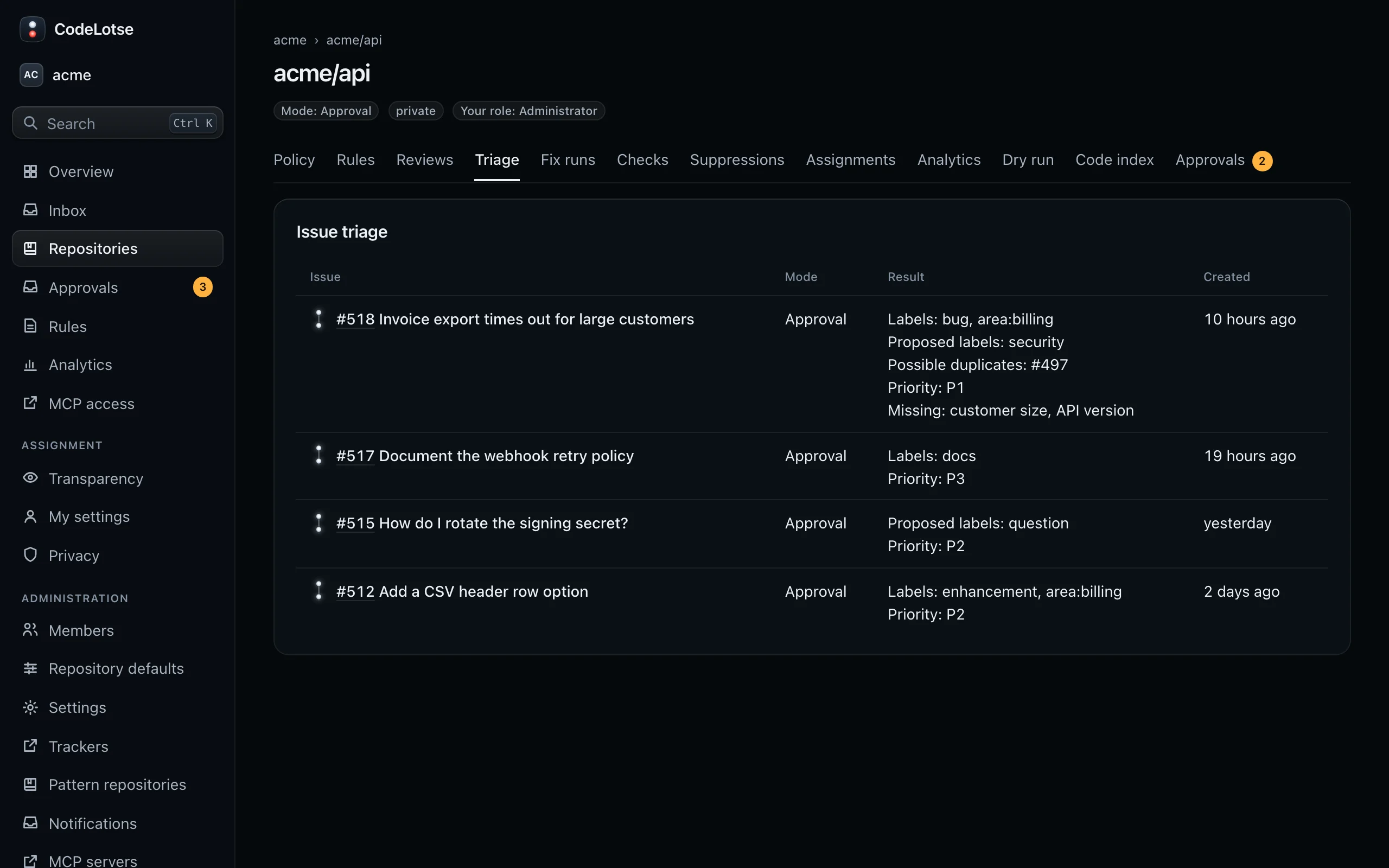
Replies on issues ​
Replies to issues answers an issue author when the repository's code, documentation and issues contain the answer. It runs when an issue is opened and on new comments in issues.
- A reply is one of three kinds: an answer, a workaround or a clarifying question. Answers and workarounds must cite sources from the same repository. When CodeLotse is not sure, it says nothing.
- At most three replies per issue and 20 per day by default (Maximum replies per issue, Maximum replies per day), and only above Minimum reply confidence.
- First-time contributors get no reply unless Reply to first-time contributors is on.
- CodeLotse never replies to bots or to its own comments.
- On public repositories replies always wait for approval, even in Automatic mode.
Set it under Replies to issues › Reply mode in the policy. The modes are the same as for triage.
Answers in pull requests ​
Commands and questions in pull request comments are a separate feature, Commands in pull requests. See Commands in comments.